We left early today to travel through rather pretty hilly country Into Castilla Y Leon, which was drier with cattle, wheat and stone walls. Our first stop was Avila, which was a lovely old medieval fortified city with well- preserved city walls with 88 turrets. It has been the residence of nobles and is famous as the birth place of St Theresa in the 16th century. She started the first barefoot Carmelite community, a strict religious community. The setting was stunning, but I personally preferred Toledo.
Then we travelled to Salamanca across 'las vegas' (the plains)which had red soil and were heavily cultivated with wheat and corn. Salamanca was a beautiful city, with most of the buildings an attractive golden stone. It has one of the oldest universities of Europe, especially for medicine, so there were students everywhere. What a magnificent campus with a very ornate facade and cloister. The huge cathedral, dating back to the 11th century was also lovely. The Plaza Major, the cathedral and the baroque facade of the university were special sites. Students are reputed to have good luck if they can find a statue of a skull with a frog on its forehead!
Then it was on into Portugal, which became independent from Spain in the 1130s. Portugal became rich as a country in the 16th century through its explorers such as Vasco da Gama and Marco Polo. The Portuguese Empire only extended from the Iberian Peninsula in the 19th century to places such as Angola, Mozambique, Rhodesia, Macau and Brazil.Portugal had a dictator until 1976, since when it has been a democracy with a president and a prime minister.
The Portuguese landscape was hillier, rockier and more forested than Spain, mostly pines and eucalyptus. It was a very long day, as we left at 8am and didn't get to until after 7 pm.
Tuesday, 25 September 2012
Monday, 24 September 2012
Madrid two
After all morning in Toledo, we only had time for a snatched lunch, after which we did a bus tour around Madrid. It was similar to our trip yesterday, but this time in sunshine. This huge city has a population of more than 4 million and is the epicentre for all roads crossing Spain, with many immigrants coming from Romania, Morocco, Ecuador and Colombia. Apparently Romanian pickpockets are a huge problem - they are often well dressed young girls or businessmen in suits and ties! One of our tour group of 41 was jostled yesterday! The Prado area has 3 beautiful fountains, dedicated to Neptune, Apollo and Sybille; the neo-classical Prado and Sophia museums , the most famous Spanish artists being Picasso, Dali and Velazquez. The modern Atocha train station is amazing and almost a gallery itself.In the posh Salamanca district it apparently costs 4-5 million euros to buy an apartment here! No problem? Las Ventas Bull ring was magnificent and can hold 23,000, with bull fights every Sunday from May to October(see photo). There are very few high buildings in the city , which is apparently also built over a hidden river. The Real Madrid soccer stadium can hold 85,000.We saw throngs going to a soccer match last night. Madrid has lots of lovely trees and boulevards which are important for stemming pollution, which is apparently a huge problem in Madrid. The beautiful botanic gardens have over 15,000 trees.Margaret and I decided to give the museums a miss and came back to the hotel for a quiet sangria, as we have a long day tomorrow. We have to get up at 6.30 and we will travel to Salamanca, near where Wellington routed Napoleon's army in 1812, ending up in Coimbra in Portugal.
Toledo
Wow! What a fabulous old city, the old capital of Spain. Spain is divided into 17 regions or Castiga and Toledo is in La Mancha, of Don Quixote fame. It has a hugely interesting history- Romans, Goths, Arabs and Spanish, being the religious and political capital of Spain from the 600s. It is surrounded by agriculture - wheat, olives and wine with its continental climate - minus 15 in winter and up to 45 degrees in summer! Toledo is absolutely stunning, with amazing stone architecture and quaint narrow cobbled streets.The gigantic Gothic cathedral (60 metres long)made in granite and limestone was really majestic.It was finished in 1493 and took 200 years to build. Our guide, Antonio had a great sense of humour eg ABC= another bloody cathedral ! We also saw one of El Greco's most famous paintings in a special little chapel called 'The Burial of Count Orgaz'. Our final stop for the morning was a Damascene steel workshop, which besides inlaid armour, made the most beautiful hand crafted jewellery. I bought myself a lovely bracelet here.
Sunday, 23 September 2012
Madrid one
Another full day of travelling! I both arrived and left Cadaques in the dark. A pity as there would have been some wonderful vistas. The bus trip to Madrid was all on a motorway and I had to get a taxi to catch the train from Barcelona. From the little I saw of Barcelona, it looked rather a drab city with lots of high rise apartment blocks. The Spanish Renfe train is amazingly comfortable. It roars along at 300kmph and has headphones and even a movie en route! The land looked quite fertile around Barcelona, but it got progressively drier and browner as we headed west.(see photos). It was a very bleak landscape, except where there was water and very few signs of habitation.
I arrived in Madrid about 1.30pm and Margaret and I did the Madrid city bus tour in the rain this afternoon. Apparently the first rain in 5 months. There are some really beautiful buildings,churches, fountains, parks and boulevards. La Gran Via had especially nice architecture from 1910 -1920s, because the old buildings were demolished! More tomorrow when we have done our walking tour. We are also going out to Toledo which Miguel, our tour leader, says is a stunning old walled city above the Tagus and full of history.
Saturday, 22 September 2012
Cadaques again
I have fallen in love with this picturesque little town. It has a wonderful ambience and food to die for. The sun is shining today so I am just off for a swim in the sea.The Dali museum was disappointing, as it was just photos of his life and not the surrealist art I was expecting. As a pensioner I am a 'jubilat' here in Spain!i I head to Madrid tomorrow by bus and train to start my second Cosmos tour with Pele's mother, Margaret.
Friday, 21 September 2012
Cadaques by night
This is such a romantic little town. After my siesta, I resurfaced about 7pm and just wandered. It has quaint little steep streets and alleyways and really comes alive at night. Motorbikes roar up and down the narrow cobbled streets and people sit in their doorways and chat. Apparently there are 120 restaurants here and I've discovered an authentic Catalan one called L'Hosta, which has been a meeting place for famous artists and is also a nightclub. Dali designed their logo and their Catalan spinach tonight was delicious. The Ubaldo has also been an excellent choice of hotel as it is in centre of the old town and is clean and comfortable. The only disadvantage are the steep stairs and no lift!
Thursday, 20 September 2012
Cadaques
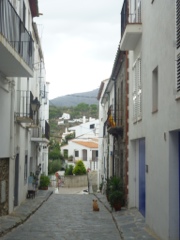
Oops! I am a bit tipsy after a late tapas brunch and 2 wines in a cafe on the waterfront!! Cadaques is a charming little fishing village on the southern side of the Cap de Creus peninsula. It was made famous by Salvador Dali and the Surrealist movement and it is absolutely gorgeous. Unfortunately it is a little grey today but still warm and not too many tourists, as it is the end of the season and great sales in the little shops. This morning I did some shopping and a trip around Cadaques and Port Lligat in this funny little train for about an hour. It was just me and a bus load of very lively elderly (ie. older than me!) Spanish tourists who hollered and sang all the way. It was very funny. I have just had a wee siesta, but it is quite noisy below - there is constant chatter in Spanish, dogs barking and seagulls squawking. Tomorrow I will go to the Salvador Dali museum.
Subscribe to:
Posts (Atom)